Atgal
į pagrindinį puslapį
Kas tai yra mokslas ir kas nėra mokslu?
English Русский Lietuvių
Mokslas yra tai, ką galima stebėti, ir su kuom galima atlikti
atkartojamus eksperimentus – viskas, kas tenkina šiuos kriterijus, yra
mokslas; tuo tarpu viskas, kas netinkina šitų kriterijų, nėra mokslu.
Atkreipsime dėmesį, kad daugelis žmonių neturi net žalio supratimo, kas
tai yra mokslas ir kas nėra mokslu.
Šitaip yra dėl labai paprastos
priežasties.
Universitetai turi didžiulį skaičių fakultetų, kurie iš tikrųjų neturi
nieko bendro su mokslu.
Kaip, pavyzdžiui, daugelis universitetų turi
„teologijos fakultetą“, arba „literatūros fakultetą“, ir taip toliau.
Ir šie „fakultetai“ išduoda diplomus su akademiniais laipsniais, kaip
kad pavyzdžiui, „magistras“, „daktaras“, „profesorius“ ir t.t.
Ir kokia gi yra tokių „teologijos profesorių“ veikla, kuom gi jie
užsiima?
Jie studijuoja kliedesinius raštus vadinamus „šventaisiais
raštas“ ir tada diskutuoja tarpusavyje apie tai, ką
Jėzus/Mahometas/Krišna/etc pasakė ir kuris yra viršesnis už kurį – ar
Jėzus yra viršesnis už Mahometą ar atvirkščiai.
Jie gali diskutuoti, ką tiktais jie nori, tačiau tai nėra mokslas, visa
šita veikla neatitinka mokslinių kriterijų.
Ir tada tokie žmonės iš
universitetų su akademiniais laipsniais rašo knygas, skaito paskaitas,
kalba per TV/radiją, ir t.t. – jie su savo kliedesine medžiaga tiesiog
užtvindo visą visuomenę.
Šie kliedesių rašinėtojai cituoja vienas kitą
tūkstančiais citatų, dalina vienas kitam apdovanojimus/ordinus/t.t. ir
tokiu būdu sudaro įspūdį, kad jie atseit veikia kažką labai prasmingo
ir naudingo.
Kai statistiniai–vidutiniokai paprasti žmonės skaito/klauso šią
kliedesinę medžiagą, tai jie susidaro klaidingą įspūdį, kad atseit ši
medžiaga yra „mokslas“ – ir tas yra dėl paprastos priežasties: tos
kliedesinės medžiagos autoriai turi akademinius/mokslinius laipsnius ir
priklauso visokiems universitetams/institutams/etc.
Viso to rezultate, dauguma žmonių yra visiškai nepajėgūs atskirti
mokslą
nuo pseudomokslo, jie yra visiškai nepajėgūs atpažinti rekursinius
apibrėžimus, ir jie yra visiškai nepajėgūs suprasti, kad rekursiniai
apibrėžimai yra beprasmiai pagal apibrėžimą.
Tai yra didžiulė problema
visuomenėje.
Žmonių populiacijoje yra gana didelis procentas visokių
menininkų/humanitarų/t.t., kurių veikla neturi nieko bendra su mokslu,
tačiau šie žmonės taip pat nori valgyti.
Ir čia jiems kyla klausimas: kaip padaryti, kad visuomenė juos maitintų?
Ir sprendimas čia yra labai paprastas – jiems tiesiog reikia mimikruoti
esant „mokslininkais“, kad visuomenė manytų, jog jų pseudomokslinė
veikla atseit yra naudinga visuomenei.
Norėdami pasiekti šį tikslą, pseudomokslininkai-humanitarai nesiskaito
su priemonėmis: jie užtvindo visuomenę su savo šizoteriniais tekstais,
jie perrašo/klastoja termino „mokslas“ apibrėžimą enciklopedijose ir
Vikipedijose ir t.t.
Tačiau visus jų pseudomokslinius kliedesius galima labai paprastai
demaskuoti: mokslas yra tai, ką galima stebėti, ir su kuom galima
atlikti atkartojamus eksperimentus – viskas, kas tenkina šiuos
kriterijus, yra mokslas; tuo tarpu viskas, kas netinkina šitų
kriterijų, nėra mokslu.
Pateiksime keletą pavyzdžių.
Ar tikrai psichologija yra mokslas?
Zigmundas Froidas yra vienas svarbiausių psichologijos autoritetų.
Zigmundo Froido psichoanalizė yra pseudomokslas ir neatitinka mokslinių
kriterijų.
| https://en.wikipedia.org/wiki/List_of_topics_characterized_as_pseudoscience
|
List of topics characterized as
pseudoscience
<...>
Psychoanalysis – body of ideas developed by Austrian physician Sigmund
Freud and his followers, which is devoted to the study of human
psychological functioning and behavior. It has been controversial ever
since its inception. Karl Popper characterized it as pseudoscience
based on psychoanalysis failing the requirement for falsifiability.
Frank Cioffi argued that "though Popper is correct to say that
psychoanalysis is pseudoscientific and correct to say that it is
unfalsifiable, he is mistaken to suggest that it is pseudoscientific
because it is unfalsifiable. […] It is when [Freud] insists that he has
confirmed (not just instantiated) [his empirical theses] that he is
being pseudoscientific.
|
| Wikipedia |
Yra labai lengva parodyti, kad Zigmundo Froido psichoanalizė yra
pseudomoksliniai kliedesiai.
Pseudomokslininkai dažnai vartoja terminus (kuriuos išgalvojo Zigmundas
Froidas): 1) Id, 2) Ego ir 3) Super-Ego.
| https://en.wikipedia.org/wiki/Id,_ego_and_super-ego
|
Id, ego, and super-ego are the
three parts of the psychic apparatus defined in Sigmund Freud's
structural model of the psyche; they are the three theoretical
constructs in terms of whose activity and interaction our mental life
is described. According to this model of the psyche, the id is the set
of uncoordinated instinctual trends; the super-ego plays the critical
and moralizing role; and the ego is the organized, realistic part that
mediates between the desires of the id and the super-ego. The super-ego
can stop one from doing certain things that one's id may want to do.
|
| Wikipedia |
| https://ru.wikipedia.org/wiki/Фрейд,_Зигмунд
|
На основании полученных данных
Фрейд разработал концепцию психической организации, выделив три
структурных элемента личности: «Оно» (или «Ид», нем. Das es), «Я» (или
«Эго», нем. Ego) и «Сверх-Я» (или «Супер-Эго», нем. Das Über-Ich).
|
| Wikipedia |
Iškelkime paprastus klausimus:
1) Ar yra kokių nors laboratorinių tyrimų, kurių pagalba būtų galima
nustatyti, ar konkretus objektas X (žmogus/gyvūnas/t.t.) turi „Id“, ar
neturi? Koks yra tikslus požymių sąrašas, kuriuo remiantis būtų galima
įrodyti, kad objektas X turi „Id“? Kaip mes galime būti tikri, kad
objektas X turi „Id“, ar neturi? Kaip kad pavyzdžiui, ar ameba turi
„Id“, ar neturi?
2) Ar yra kokių nors laboratorinių tyrimų, kurių pagalba būtų galima
nustatyti, ar konkretus objektas X (žmogus/gyvūnas/t.t.) turi „Ego“, ar
neturi? Koks yra tikslus požymių sąrašas, kuriuo remiantis būtų galima
įrodyti, kad objektas X turi „Ego“? Kaip mes galime būti tikri, kad
objektas X turi „Ego“, ar neturi? Kaip kad pavyzdžiui, ar ameba turi
„Ego“, ar ne neturi?
3) Ar yra kokių nors laboratorinių tyrimų, kurių pagalba būtų galima
nustatyti, ar konkretus objektas X (žmogus/gyvūnas/t.t.) turi
„Super-Ego“, ar neturi? Koks yra tikslus požymių sąrašas, kuriuo
remiantis būtų galima įrodyti, kad objektas X turi „Super-Ego“? Kaip
mes galime būti tikri, kad objektas X turi „Id“, ar neturi? Kaip kad
pavyzdžiui, ar ameba turi „Super-Ego“, ar neturi?
Pseudomokslininkai, vartojantys terminus „Id/Ego/Super-Ego“, negali
mums pateikti šių terminų mokslinių apibrėžimų, jie negali mums
pateikti diagnostinių kriterijų sąrašo (t.y. savybių sąrašo), kuris
leistų mums nustatyti, ar objektas X turi „Id/Ego/Super-Ego“, ar neturi.
Jeigu žmogus vartoja terminą/žodį, kurio jis negali apibrėžti, tai
akivaizdu, kad toks žmogus pats nesupranta apie ką šneka; akivaizdu,
kad jo šnekos yra beprasmės pagal apibrėžimą.
Įdomu tai, kad pseudomokslinių kliedesių, kurių pavadinimas yra
„psichoanalizė“, pasekėjai netgi nežino, kad Zigmundas Froidas savo
pacientus „gydė“ naudodamas kokainą, ir kad pats Zigmundas Froidas buvo
kokaino narkomanas ir kad Froido psichoanalitinė teorija yra kokaininių
haliucinacijų produktas.
| https://en.wikipedia.org/wiki/Sigmund_Freud#Cocaine
|
As a medical researcher, Freud
was an early user and proponent of cocaine as a stimulant as well as
analgesic. He believed that cocaine was a cure for many mental and
physical problems, and in his 1884 paper "On Coca" he extolled its
virtues. Between 1883 and 1887 he wrote several articles recommending
medical applications, including its use as an antidepressant. He
narrowly missed out on obtaining scientific priority for discovering
its anesthetic properties of which he was aware but had mentioned only
in passing. (Karl Koller, a colleague of Freud's in Vienna, received
that distinction in 1884 after reporting to a medical society the ways
cocaine could be used in delicate eye surgery.) Freud also recommended
cocaine as a cure for morphine addiction. He had introduced cocaine to
his friend Ernst von Fleischl-Marxow who had become addicted to
morphine taken to relieve years of excruciating nerve pain resulting
from an infection acquired while performing an autopsy. His claim that
Fleischl-Marxow was cured of his addiction was premature, though he
never acknowledged he had been at fault. Fleischl-Marxow developed an
acute case of "cocaine psychosis", and soon returned to using morphine,
dying a few years later after more suffering from intolerable pain.
The application as an anesthetic turned out to be one of the few safe
uses of cocaine, and as reports of addiction and overdose began to
filter in from many places in the world, Freud's medical reputation
became somewhat tarnished.
After the "Cocaine Episode" Freud ceased to publicly recommend use of
the drug, but continued to take it himself occasionally for depression,
migraine and nasal inflammation during the early 1890s, before
discontinuing in 1896. In this period he came under the influence of
his friend and confidant Fliess, who recommended cocaine for the
treatment of the so-called nasal reflex neurosis. Fliess, who operated
on the noses of several of his own patients, also performed operations
on Freud and on one of Freud's patients whom he believed to be
suffering from the disorder, Emma Eckstein. The surgery proved
disastrous. It has been suggested that much
of Freud's early psychoanalytical theory was a by-product of his
cocaine
use.
|
| Wikipedia |
| https://www.pbs.org/newshour/bb/health-july-dec11-addiction_10-17/
|
Freud published journal articles
proclaiming cocaine was the cure. But he also had a more personal
interest in the drug’s effects.
<…>
Freud loved the way cocaine made him feel.
<…>
In the 1890s, after almost killing a patient while under the influence
of cocaine, Freud stopped using the drug.
|
| Wikipedia |
| https://ru.wikipedia.org/wiki/Фрейд,_Зигмунд
|
В 1884 году Фрейд прочёл об
опытах некоего немецкого военного врача с новым препаратом — кокаином.
В научных работах фигурировали заявления о том, что данное вещество
способно повысить выносливость и значительно снизить утомляемость.
Фрейд крайне заинтересовался прочитанным и решил провести ряд опытов на
себе. Первое упоминание данного вещества учёным датировано 21 апреля
1884 года — в одном из писем Фрейд отмечал: «Я раздобыл немного кокаина
и попробую испытать его воздействие, применив в случаях сердечных
заболеваний, а также нервного истощения, в особенности при ужасном
состоянии отвыкания от морфия». Действие кокаина произвело на учёного
сильнейшее впечатление, препарат был охарактеризован им как эффективный
анальгетик, дающий возможность проводить сложнейшие хирургические
операции; восторженная статья о веществе вышла из-под пера Фрейда в
1884 году и получила название «О коке». Долгое время учёный использовал
кокаин как обезболивающее средство, употребляя его самостоятельно и
выписывая своей невесте Марте. Восхищённый «волшебными» свойствами
кокаина Фрейд настоял на его использовании своим другом Эрнстом
Флейшлем фон Марксовым, который был болен тяжёлым инфекционным
заболеванием, перенёс ампутацию пальца и страдал сильнейшими головными
болями (и к тому же страдал от морфиновой зависимости). В качестве
лекарства от злоупотребления морфием Фрейд и посоветовал другу
использовать кокаин. Желаемого результата достичь так и не удалось —
фон Марксов впоследствии быстро пристрастился к новому веществу, и у
него начались частые приступы, схожие с белой горячкой,
сопровождавшиеся страшнейшими болями и галлюцинациями. В это же время
со всех концов Европы начали поступать сообщения об отравлениях
кокаином и привыкании к нему, о плачевных последствиях его употребления.
Однако энтузиазм Фрейда не уменьшался — он исследовал кокаин как
анестезирующее средство при различных хирургических операциях. Итогом
работы учёного стала объёмная публикация в «Центральном журнале общей
терапии» о кокаине, в которой Фрейд изложил историю употребления
листьев коки южноамериканскими индейцами, описал историю проникновения
растения в Европу и подробно изложил результаты собственных наблюдений
за эффектом, производимым употреблением кокаина. Весной 1885 года
учёный прочёл лекцию, посвящённую данному веществу, в которой признал
возможные негативные последствия от его употребления, но при этом
отметил, что не наблюдал никаких случаев привыкания (это происходило до
ухудшения состояния фон Марксова). Фрейд закончил лекцию словами: «Я,
не колеблясь, советую применять кокаин в подкожных инъекциях по 0,3—0,5
грамма, не беспокоясь о его накапливании в организме». Критика не
заставила себя ждать — уже в июне появились первые крупные работы,
осуждающие позицию Фрейда и доказывающие её несостоятельность. Научная
полемика относительно целесообразности применения кокаина продолжалась
вплоть до 1887 года. В этот период Фрейд опубликовал ещё несколько
работ — «К вопросу об изучении действия кокаина» (1885), «Об общем
воздействии кокаина» (1885), «Кокаиномания и кокаинофобия» (1887).
К началу 1887 года наука окончательно развенчала последние мифы о
кокаине — он «был публично осуждён как одно из бедствий человечества,
наряду с опиумом и алкоголем». Фрейд, к тому моменту уже
кокаинозависимый, вплоть до 1900 года страдал от головных болей,
сердечных приступов и частых кровотечений из носа. Примечательно, что
разрушительное воздействие опасного вещества Фрейд не только испытал на
себе, но и невольно (поскольку на тот момент пагубность кокаинизма ещё
не была доказана) распространил на многих знакомых. Этот факт его
биографии Э. Джонс упорно скрывал и предпочитал не освещать, однако
данная информация стала достоверно известна из опубликованных писем, в
которых Джонс утверждал: «До того, как опасность наркотиков была
определена, Фрейд уже представлял социальную угрозу, так как он толкал
всех, кого знал, принимать кокаин».
|
| Wikipedia |
Dar vienas iš svarbiausių psichologijos autoritetų yra Karlas Gustavas
Jungas.
Labai lengva parodyti, kad Karlo Gustavo Jungo darbai yra
pseudomoksliniai kliedesiai.
Pseudomokslininkai intensyviai vartoja terminus (kuriuos išgalvojo
Karlas Gustavas Jungas): anima, animus, trickster, puer, puella ir t.t.
Pseudomokslininkai teigia, kad anima, animus, trickster, puer, puella
yra reiškiniai, kurie yra patys savaime nėra pažintini.
| https://en.wikipedia.org/wiki/Jungian_archetypes
|
Strictly speaking, Jungian
archetypes refer to unclear underlying forms or the
archetypes-as-such from which emerge images and motifs such as the
mother, the child, the trickster, and the flood among others.
<...>
Jung described archetypal events: birth, death, separation from
parents, initiation, marriage, the union of opposites; archetypal
figures: great mother, father, child, devil, god, wise old man, wise
old woman, the trickster, the hero; and archetypal motifs: the
apocalypse, the deluge, the creation. Although the number of archetypes
is limitless, there are a few particularly notable, recurring
archetypal images, "the chief among them being" (according to Jung)
"the shadow, the wise old man, the child, the mother ... and her
counterpart, the maiden, and lastly the anima in man and the animus in
woman". Alternatively he would speak of "the emergence of certain
definite archetypes ... the shadow, the animal, the wise old man, the
anima, the animus, the mother, the child".
|
Wikipedia
|
| https://www.jungchicago.org/pages.php?page=ap
|
Archetype
The inherited part of the PSYCHE; structuring patterns of psychological
performance linked to INSTINCT; a hypothetical entity
irrepresentable in itself and evident only through its
manifestations.
(Andrew Samuels, Bani Shorter and
Fred Plaut. A Critical Dictionary of Jungian Analysis, Routledge: New
York, 1986, pp. 26-28.)
<...>
the human psyche constellated in sub-personalities or archetypal
representations identifiable as Persona, Ego, Shadow, Anima, Animus,
Wise Old Man, Great Mother and the Self; finally, Individuation seen as
the process which in the course of a lifetime leads a person to a
unification of his personality which is expressive of his basic
wholeness.
(Andrew Samuels, Bani Shorter and Fred Plaut. A Critical Dictionary of
Jungian Analysis, Routledge: New York, 1986, pp. 21-22.)
|
C.G. Jung Institute of Chicago
|
| https://vm.msun.ru/Oixt/Filosof/Arhetip.htm
|
Архетип К.Юнга
(A. Samuels, ... A Critical Dictionary of Jungian Analysis, London,
1968)
Архетип является гипотетической конструкцией, явлением самим по себе не
познаваемым.
<…>
Архетипы (от греч. arche – начало + typos – образ) — элементы
коллективного бессознательного. Представляют собой врожденные
диспозиции, обусловливающие появление у конкретного индивида
определенных мыслей, представлений, отношений, действий, снов. <…>
Автор К.Г. Юнг (1916 г.).
Виды: анима, анимус, отец, мать, трикстер, puer и puella. При этом они
объединяются в несколько групп: архетипы души (анима, анимус), архетипы
духа (Мудрый старик, Большая мать) и, наконец, архетип самости
(Selbst).
Литература.
Jung C.G. Von den Wurzeln des Bewusstseins. Zurich: Rascher, 1954;
Jung C.G. Die Dynamik des Unbewussten. Ges. Werke. Bd. 8. Zurich:
Rascher, 1967.
|
| Wikipedia |
Iškelkime keletą paprastų klausimų:
1) Ar yra kokių nors laboratorinių tyrimų, kurių pagalba būtų galima
nustatyti, ar konkretus objektas X (žmogus/gyvūnas/t.t.) turi „anima“,
ar neturi? Koks yra tikslus požymių sąrašas, kuriuo remiantis būtų
galima įrodyti, kad objektas X turi „anima“? Kaip mes galime būti
tikri, kad objektas X turi „anima“, ar neturi? Kaip kad pavyzdžiui, ar
ameba turi „anima“, ar neturi?
2) Ar yra kokių nors laboratorinių tyrimų, kurių pagalba būtų galima
nustatyti, ar konkretus objektas X (žmogus/gyvūnas/t.t.) turi „animus“,
ar neturi? Koks yra tikslus požymių sąrašas, kuriuo remiantis būtų
galima įrodyti, kad objektas X turi „animus“? Kaip mes galime būti
tikri, kad objektas X turi „animus“, ar neturi? Kaip kad pavyzdžiui, ar
ameba turi „animus“, ar neturi?
3) Ar yra kokių nors laboratorinių tyrimų, kurių pagalba būtų galima
nustatyti, ar konkretus objektas X (žmogus/gyvūnas/t.t.) turi
„trickster“, ar neturi? Koks yra tikslus požymių sąrašas, kuriuo
remiantis būtų galima įrodyti, kad objektas X turi „trickster“? Kaip
mes galime būti tikri, kad objektas X turi „trickster“, ar neturi? Kaip
kad pavyzdžiui, ar ameba turi „trickster“, ar neturi?
4) ir taip toliau.
Pseudomokslininkai, vartojantys terminus
„anima/animus/trickster/puer/puella/t.t.“, negali mums pateikti šių
terminų mokslinių apibrėžimų, jie negali mums pateikti diagnostinių
kriterijų sąrašo (t.y. savybių sąrašo), kuris leistų mums nustatyti, ar
objektas X turi „anima/animus/trickster/puer/puella/t.t.“, ar neturi.
Jeigu žmogus vartoja terminą/žodį, kurio jis negali apibrėžti, tai
akivaizdu, kad toks žmogus pats nesupranta apie ką šneka; akivaizdu,
kad jo šnekos yra beprasmės pagal apibrėžimą.
Ir Karlas Gustavas Jungas, ir Zigmundas Froidas – abudu girdėjo balsus
galvose ir patyrė haliucinacijas.
| https://www.hearing-voices.org/about-voices/famous-people/
|
Famous People Who Hear Voices
Many famous and noted people have spoken about their voice-hearing
experiences in the media. We’ve included a few of these people below.
<...>
Sigmund Freud (Father of Psychoanalysis)
“During the days when I was living alone in a foreign city … I quite
often heard my name suddenly called by an unmistakable and beloved
voice. I then noted down the exact moment of the hallucination and made
anxious enquiries of those at home about what had happened at that
time. Nothing had happened.”
|
| Hearing Voices Network. June 3,
2012 |
| https://www.voicecollective.co.uk/about-voices/who-hears-voices/
|
Famous people who hear (or have
heard) voices
<....>
Sigmund Freud (The founder of psychoanalysis)
“During the days when I was living alone in a foreign city … I quite
often heard my name suddenly called by an unmistakable and beloved
voice;
I then noted down the exact moment of the hallucination and made
anxious enquiries if those at home about what had happened at that
time. Nothing had happened.”
<....>
Carl Jung (Swiss psychiatrist)
Jung wrote about experiencing lots of different visions and voices. He
thought some of these were parts of his subconscious, but believed that
others were supernatural.
One of the voices he heard (Philemon) appeared to him when he needed
advice or guidance.
|
Voice Collective
|
Kai Karlui Gustavui Jungui buvo 38 metai, jis pradėjo girdėti balsus
galvoje.
Haliucinacijų metu Karlas Gustavas Jungas bendravo su senu vyru,
bibliniu pranašu Eliju, ir su jauna mergina, žydų princese Salomėja, o
taip pat Jungas bendravo su juodu smaugliu.
Vėliau biblinis pranašas Elijas pavirto į dvasią-mokytoją, kurią Jungas
pavadino „Filemonu“.
Žemiau yra pateiktas Filemono paveikslėlis, kurį nupiešė pats Jungas.
Šis Filemonas yra toji pati dvasia-mokytoja, su kuria Jungas nuolat
bendravo savo haliucinacijų metu, ir iš kurios Jungas gaudavo visas
savo žinias.
Jungas savo haliucinacines vizijas užrašydavo į dienoraščius, kuriuos
Jungo giminaičiai laikė paslaptyje netgi ilgai po Jungo mirties, ir
tiktais 2009 metais pagaliau išdrįso šiuos dienoraščius publikuoti.
Karlo Gustavo Jungo haliucinacinių vizijų dienoraščiai buvo publikuoti
knygoje, kurios pavadinimas yra „Raudonoji knyga“.
https://www.jungiananalystvt.com/ThePhilemonFoundationTendingtoJungsLegacy.en.html
|
The Philemon Foundation: Tending
to Jung's Legacy
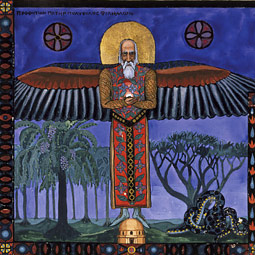
Philemon
Jung's painting of Philemon, a recurrent presence in his dreams, from
his recently published personal journal, The Red Book.
"Philemon was simply a superior knowledge, and he taught me
psychological objectivity and the actuality of the soul. He formulated
and expressed everything which I had never thought." (C.G. Jung)
The Philemon Foundation is a non-profit foundation made of of an
expanding group of scholars, board members and donors dedicating to
preparing for publication the Complete Works of C.G.
|
| David C. Hamilton, Jungian
Analyst, IAAP Burlington & Middlebury, Vermont |
https://en.wikipedia.org/wiki/The_Red_Book_(Jung)
|
The Red Book is a red
leather‐bound folio manuscript crafted by the Swiss physician and
psychologist Carl Gustav Jung between 1915 and about 1930. It recounts
and comments upon the author's imaginative experiences between 1913 and
1916, and is based on manuscripts first drafted by Jung in 1914‐15 and
1917. Despite being nominated as the central work in Jung’s oeuvre, it
was not published or made otherwise accessible for study until 2009.
In October 2009, with the cooperation of Jung's estate and after 13
years of exhaustive editorial work by Sonu Shamdasani, The Red Book:
Liber Novus was published by W. W. Norton in a facsimile edition,
complete with an English translation, a comprehensive introduction
written by Shamdasani, three appendices, and over 1500 editorial notes.
Editions and translations in several other languages soon followed.
In December 2012, Norton additionally released a "Reader's Edition" of
the work; this smaller format edition includes the complete translated
text of The Red Book: Liber Novus along with the introduction and notes
prepared by Shamdasani, but it omits the facsimile reproduction of
Jung's original calligraphic manuscript.
While the work has in past years been descriptively called simply "The
Red Book", Jung did emboss a formal title on the spine of his
leather-bound folio: he titled the work Liber Novus (in Latin, the "New
Book"). His manuscript is now increasingly cited as Liber Novus, and
under this title implicitly includes draft material intended for but
never finally transcribed into the red leather folio proper.
Context and composition
Jung was associated with Sigmund Freud for a period of approximately
six years, beginning in 1907. Over those years, their relationship
became increasingly acrimonious. When the final break of the
relationship came in 1913, Jung retreated from many of his professional
activities to intensely reconsider his personal and professional path.
The creative activity that produced Liber Novus came in this period,
from 1913 to about 1917.
Biographers and critics have disagreed whether these years in Jung's
life should be seen as "a creative illness, a period of introspection,
a psychotic break, or simply madness." Anthony Storr, reflecting on
Jung's own judgment that he was "menaced by a psychosis" during this
time, concluded that the period represented a psychotic episode.
According to Sonu Shamdasani, Storr's opinion is untenable in light of
currently available documentation.
During the years Jung engaged with his "nocturnal work" on Liber Novus,
he continued to function in his daytime activities without any evident
impairment. He maintained a busy professional practice, seeing on
average five patients a day. He lectured, wrote, and remained active in
professional associations. Throughout this period he also served as an
officer in the Swiss army and was on active duty over several extended
periods between 1914 and 1918, the years of World War I in which Jung
was composing Liber Novus. Jung was not "psychotic" by any accepted
clinical criteria during the period he created Liber Novus.
Nonetheless, what he was doing during these years defies facile
categorization.
Jung referred to his imaginative or visionary venture during these
years as "my most difficult experiment." This experiment involved a
voluntary confrontation with the unconscious through willful engagement
of what Jung later termed "mythopoetic imagination". In his
introduction to Liber Novus, Shamdasani explains:
"From December 1913 onward, he carried on in the same procedure:
deliberately evoking a fantasy in a waking state, and then entering
into it as into a drama. These fantasies may be understood as a type of
dramatized thinking in pictorial form.... In retrospect, he recalled
that his scientific question was to see what took place when he
switched off consciousness. The example of dreams indicated the
existence of background activity, and he wanted to give this a
possibility of emerging, just as one does when taking mescaline."
Jung initially recorded his "visions", or "fantasies, or "imaginations"
— all terms used by Jung to describe his activity — in a series of six
journals now known collectively as the "Black Books". This journal
record begins on 12 November 1913, and continues with intensity through
the summer of 1914; subsequent entries were added up through at least
the 1930s. Biographer Barbara Hannah, who was close to Jung throughout
the last three decades of his life, compared Jung's imaginative
experiences recounted in his journals to the encounter of Menelaus with
Proteus in the Odyssey. Jung, she said, "made it a rule never to let a
figure or figures that he encountered leave until they had told him why
they had appeared to him."
After the outbreak of World War I in August 1914, Jung perceived that
his visionary experience was not only of personal relevance, but
entwined with a crucial cultural moment. In late-1914 and 1915 he
compiled the visions from the journals, along with his additional
commentary on each imaginative episode, into an initial manuscript.
This manuscript was the beginning of Liber Novus.
In 1915 Jung began artfully transcribing this draft text into the
illuminated calligraphic volume that would subsequently become known as
the Red Book. In 1917 he compiled a further supplementary manuscript of
visionary material and commentary, which he titled "Scrutinies"; this
also was apparently intended for transcription into his red folio
volume, the "Red Book". Although Jung labored on the artful
transcription of this corpus of manuscript material into the
calligraphic folio of the Red Book for sixteen years, he never
completed the task. Only approximately two-thirds of Jung's manuscript
text was transcribed into the Red Book by 1930, when he abandoned
further work on the calligraphic transcription of his draft material
into the Red Book. The published edition of The Red Book: Liber Novus
includes all of Jung's manuscript material prepared for Liber Novus,
and not just the portion of the text transcribed by Jung into the
calligraphic red book volume.
In 1957, near the end of his life, Jung spoke to Aniela Jaffé about the
Red Book and the process which yielded it; in that interview he stated:
"The years… when I pursued the inner images, were the most important
time of my life. Everything else is to be derived from this. It began
at that time, and the later details hardly matter anymore. My entire
life consisted in elaborating what had burst forth from the unconscious
and flooded me like an enigmatic stream and threatened to break me.
That was the stuff and material for more than only one life. Everything
later was merely the outer classification, scientific elaboration, and
the integration into life. But the numinous beginning, which contained
everything, was then."
Creation and physical description
Jung worked his text and images in the Red Book using calligraphic pen,
multicolored ink, and gouache paint. The text is written in German but
includes quotations from the Vulgate in Latin, a few inscriptions and
names written in Latin and Greek, and a brief marginal quotation from
the Bhagavad Gita given in English.
The initial seven folios (or leaves) of the book — which contain what
is now entitled Liber Primus (the "First Book") of Liber Novus — were
composed on sheets of parchment in a highly illuminated medieval style.
However, as Jung proceeded working with the parchment sheets, it became
apparent that their surface was not holding his paint properly and that
his ink was bleeding through. These first seven leaves (fourteen pages,
recto and verso) now show heavy chipping of paint, as will be noted on
close examination of the facsimile edition reproductions.
In 1915, Jung commissioned the folio-sized and red leatherbound volume
now known as the Red Book. The bound volume contained approximately 600
blank pages of paper of a quality suitable for Jung's ink and paint.
The folio-sized volume, 11.57 inches (29.4 cm) by 15.35 inches (39.0
cm), is bound in fine red leather with gilt accents. Though Jung and
others usually referred to the book simply as the "Red Book", he had
the top of the spine of the book stamped in gilt with the book's formal
title, Liber Novus ("The New Book").
Jung subsequently interleaved the seven original parchment sheets at
the beginning of the bound volume. After receiving the bound volume in
1915, he began transcribing his text and illustrations directly onto
the bound pages. Over the next many years, Jung ultimately filled only
191 of the approximately 600 pages bound in the Red Book folio. About a
third of the manuscript material he had written was never entered into
the illuminated Red Book. Inside the book now are 205 completed pages
of text and illustrations (including the loose parchment sheets), all
from Jung's hand: 53 full-page images, 71 pages with both text and
artwork, and 81 pages entirely of calligraphic text.
The Red Book is currently held, along with other valuable and private
items from Jung's archive, in a bank vault in Zurich.
Publication and display
During Jung's life, several people saw his Red Book — it was often
present in his office — but only a very few individuals who were
personally trusted by Jung had an opportunity to read it. After Jung's
death in 1961, Jung's heirs held the book as a private legacy, and
refused access to it by scholars or other interested parties.
After many years of careful deliberations, the estate of C. G. Jung
finally decided in 2000 to allow publication of the work, and
thereafter began preparations for the publication. The decision to
publish was apparently aided by presentations made by Sonu Shamdasani,
who had already discovered substantial private transcriptions of
portions of the Red Book in archival repositories. Editorial efforts
and preparation for publication were underwritten by major funding from
the Philemon Foundation.
On occasion of the publication in October 2009, the Rubin Museum of Art
in New York City displayed the original book along with three of Jung's
original "Black Book" journals and several other related artifacts;
this exhibit was open from 7 October 2009 to 25 January 2010. The Red
Book was subsequently exhibited at the Hammer Museum in Los Angeles
from April 11 – June 6, 2010. It was the center of a major display and
conference at the Library of Congress from June 17 – September 25,
2010. Thereafter, the Red Book has been the focus of museum displays in
Zurich, Geneva, Paris, and other major cities.
|
Wikipedia
|
https://psychcentral.com/blog/archives/2014/01/23/3-things-you-didnt-know-about-carl-jungs-psychosis/
|
As the founder of one of the
most influential schools of psychological thought — analytical
psychology — Carl Jung (also known as CG Jung) experienced what today
we might call a form of psychosis. It probably wasn’t a complete
psychotic break, because Jung still functioned in his daily life.
His psychosis began when he was 38 years old, when he started finding
himself haunted by visions in his head and started hearing voices. Jung
himself worried about this “psychosis” — things that today we’d might
say were consistent with symptoms of schizophrenia (a term he also used
to describe himself during this period).
Jung didn’t let these visions and hallucinations slow him down, and
continued seeing patients and actively engaging in his professional
life. In fact, he so enjoyed the unconscious mind he had unleashed, he
found a way to summon it whenever he wanted.
1. Jung actively induced his hallucinations and visions.
Most people who have psychosis or hallucinations seek to minimize their
symptoms, to drown out the visions and hallucinations. After first
experiencing these visions, Jung did just the opposite. He found the
experience so exhilarating and full of unconscious content that could
be further examined, he didn’t just wait for the visions to come on
their own. Instead, he encouraged their appearance throughout the day,
for years.
After dinner each night and inbetween seeing patients during the day,
Jung spent time in his study inducing the visions and hallucinations.
He did this not through the use of any kind of drug, apparently, but
instead through his own personal methods that allowed his unconscious
mind to become totally open and flowing forth.
2. Jung recorded everything from his psychosis.
Although modern recording equipment didn’t exist in 1913, when the
hallucinations and visions began, Jung nonetheless kept a meticulous
record of his psychosis. Jung would write down everything he saw and
heard in small black journals. He later transferred some of this
material into a large, red, leather-bound journal.
Over the course of 16 years, Jung recorded everything he experienced in
these unconscious journeys. Some of the material ended up filling 205
large pages in the red book. The book consists of intricate, colorful,
wildly detailed drawings and writings. “The Red Book,” as it was later
called, stayed locked up in a vault after Jung’s death. It was finally
published in 2009 as The Red Book and is now available for sale.
The New York Times describes the story told by the Red Book:
The book tells the story of Jung trying to face down his own demons as
they emerged from the shadows. The results are humiliating, sometimes
unsavory. In it, Jung travels the land of the dead, falls in love with
a woman he later realizes is his sister, gets squeezed by a giant
serpent and, in one terrifying moment, eats the liver of a little child.
3. Jung’s unconscious journey probably wasn’t the same as the unwanted
psychosis people experience today.
While Jung described his visions as a type of “psychosis” or
“schizophrenia,” those terms meant something different a hundred years
ago than they do today. Today, the terms describe a specific
constellation of symptoms, one of which is the meaningful and
significant interruption the disorder makes upon a person’s ordinary,
daily life.
Jung’s life, was by all accounts, not interrupted by his unconscious
thoughts. He continued experiencing them off and on for 16 years, all
the while traveling, speaking at various professional meetings, and
translating and publishing his writings in English.
Jung did suffer from isolation, but that was likely caused more by his
break from Sigmund Freud in 1915. World War I also negatively impacted
virtually everybody’s life at this time, including Jung’s.
Also, Jung reportedly found a way to bring on his unconscious stream of
thoughts and visions at will — something most people today who
experience psychosis or schizophrenia can’t do. Nor can they do the
opposite — make them go away by just willing it. If mental disorders
could simply be fixed by willpower, we’d probably have little need for
therapists or psychiatrists today.
* * *
It’s extraordinary to imagine one of the founders of modern
psychological theories experienced such visions, and used them in his
own way to form a creative work such as The Red Book.
|
3 Things You Didn’t Know About
Carl Jung’s Psychosis
By John M. Grohol, Psy.D. |
https://ru.wikipedia.org/wiki/Красная_книга_(Юнг)
|
«Красная книга», известная также
под
названием Liber Novus («новая книга») — манускрипт психолога и философа
Карла Густава Юнга, созданный им в период между 1914 и 1930 годами и
насчитывающий 205 страниц, некоторые из которых иллюстрированы автором.
К работе над «Красной книгой» Юнг приступил после разрыва с Фрейдом,
произошедшего в 1913 году. Родственники и потомки психолога долгие годы
препятствовали публикации этого важного для истории психологии
документа: лишь в 2001 году к манускрипту были допущены исследователи,
а широкая публика смогла познакомиться с книгой только после её
публикации в 2009 году. Через полгода после её выхода, Клуб Касталия в
соавторстве с эзотерической группой Inverted tree перевели текст
Красной Книги на русский язык и выложили на своих сайтах. Выпуск Книги
в твердом переплете и её презентация состоялись 22 июня 2012 года.
Контекст
Юнг сотрудничал с Фрейдом примерно в течение 5 лет, начиная с 1907
года. Их отношения со временем приобрели характер вражды и закончились
окончательным разрывом в 1913 году, когда Юнг в основном оставил
профессиональную деятельность и сосредоточился на развитии собственных
идей. Мнения биографов по поводу того, был ли это психологический срыв,
расходятся. Энтони Сторр (англ.)русск., опираясь на слова самого Юнга о
том, что он был «охвачен психозом» в то время, заключил, что это
действительно был психотический эпизод.
Сам Юнг говорил о том времени как о чем-то вроде эксперимента,
намеренного столкновения с бессознательным. Биограф Барбара Ханна
(англ.)русск., близко знавшая Юнга, позднее сравнивала этот его опыт со
встречей Менелая с Протеем (сюжет из Одиссеи). Юнг, по её словам, «взял
за правило не давать появившимся образам покидать его, пока они не
давали ему объяснения, зачем они ему явились».
О Красной книге Юнг говорил:
...Записи моих тогдашних фантазий я назвал «Черной книгой», которую
позже переименовал в «Красную книгу» и сопроводил её рисунками.
[«Черная книга» — это маленький томик в черном кожаном переплете.
«Красная книга» — своего рода фолиант в сафьяновом переплете,
напоминающий по форме средневековые рукописи; и шрифт, и язык
стилизованы в нем под готику.] В неё вошла большая часть моих рисунков
с изображением мандалы. В «Красной книге» я попытался облечь мои
фантазии в определенную эстетическую форму, но до конца эту работу не
довел. Я понял, что не нахожу пока нужных слов и должен выразить это
как-то иначе. Поэтому в какой-то момент мне пришлось отказаться от
эстетизации, обратившись лишь к смыслу. Я видел, что фантазиям
требуется некоторое твердое основание, что мне самому необходимо
спуститься на землю — вернуться в реальный мир. Но обрести основание в
реальном мире я мог, только научно осмыслив его. Я поставил перед собой
цель осмыслить данный мне бессознательным материал. И отныне это стало
смыслом всей моей жизни. Некоторую эстетизацию в «Красной книге» я
допускал еще и потому, что бесконечная череда бессознательных видений и
образов ужасно раздражала меня, — мне нужно было снять некоторые
моральные установки. Все это существенно отразилось на моем образе
жизни. Именно тогда я понял, что ничто так не влияет на нашу жизнь, как
язык: ущербный язык делает ущербной и жизнь. Дав такое объяснение
угнетавшим меня бессознательным фантазиям, я освободился от них, решая
одновременно две проблемы - интеллектуальную и моральную.
(К.Г.Юнг «Воспоминания, сновидения, размышления»)
Содержание книги
Книга была названа Юнгом «Liber Novus» («Новая книга», лат.). Рукопись
размера инфолио, 11,57 дюйма (29 см) на 15,35 дюйма (39 см), была
переплетена в красную кожу и в основном упоминается как «Красная книга»
Юнга. Внутри 205 страниц текста и иллюстраций, все они написаны от
руки: 53 содержат только изображения, 71 содержат и текст, и
иллюстрации и 81 состоят полностью из каллиграфического текста. Юнг
начал работать над книгой в 1913 году, сначала в маленьких чёрных
дневниках, во время трудного периода «творческой болезни» или
конфронтации с бессознательным. Книга предназначалась для самых личных
материалов. За 16 лет работы над книгой Юнг развил теории архетипов,
коллективного бессознательного, и индивидуации.
«Красная книга» была продуктом техники активного воображения,
разработанной Юнгом. По описанию Юнга, он был посещён двумя образами:
стариком и юной девушкой, которые отзывались о себе как Илия и Саломея.
Вместе с ними был большой чёрный удав. Со временем Илия превратился в
дух-проводник, который Юнг называл «Филемон». Саломея была
идентифицирована Юнгом как образ анима и анимус. Образы, согласно Юнгу,
«принесли мне понимание, что в психологии есть вещи, которые я не
создаю, но которые производят сами себя и имеют собственную маленькую
жизнь».
Филемон представлял озарение и общался через мифические образы. Было
непохоже, что образы приходили из личного опыта Юнга, и Юнг толковал их
как продукт коллективного бессознательного.
|
Wikipedia
|
Psichologų parašytų „mokslinių“ darbų mokslinis tyrimas atskleidė,
kad ne mažiau kaip 80 procentų psichologų „mokslinių“ darbų yra
klastotės ir pseudomoksliniai kliedesiai.
Štai tokie yra psichologijos „autoritetingi mokslininkai“, ir štai toks
„mokslas“ yra psichologija.
| https://www.theguardian.com/science/2015/aug/27/study-delivers-bleak-verdict-on-validity-of-psychology-experiment-results
|
Of 100 studies published in
top-ranking journals in 2008, 75% of social
psychology experiments and half of cognitive studies failed the
replication test.
A major investigation into scores of claims made in psychology research
journals has delivered a bleak verdict on the state of the science.
An international team of experts
repeated 100 experiments
published in top psychology journals and found that they could
reproduce only 36% of
original findings.
The study, which saw 270 scientists repeat experiments on five
continents, was launched by psychologists in the US in response to
rising concerns over the reliability of psychology research.
<…>
John Ioannidis, professor of health research and policy at Stanford
University, said the study was impressive and that its results had been
eagerly awaited by the scientific community. “Sadly, the picture it
paints - a 64% failure rate even among
papers
published in the best
journals in the field - is not very nice about the current
status
of
psychological science in general, and for fields like social psychology
it is just devastating,” he said.
|
Study delivers bleak verdict on
validity of psychology experiment results
The Guardian.
August 25, 2015 |
| https://www.theguardian.com/commentisfree/2015/aug/28/psychology-experiments-failing-replication-test-findings-science
|
Science is the best thing that
has happened to humankind because its results can be questioned,
retested, and demonstrated to be wrong. Science is not about proving at
all cost some preconceived dogma. Conversely religious devotees,
politicians, soccer fans, and pseudo-science quacks won’t allow their
doctrines, promises, football clubs or bizarre claims to be proven
illogical, exaggerated, second-rate or just absurd.
Despite this clear superiority of the scientific method, we researchers
are still fallible humans. This week, an impressive collaboration of
270 investigators working for five years published in Science the
results of their efforts to replicate 100 important results that had
been previously published in three top psychology journals. The
replicators worked closely with the original authors to make the repeat
experiments close replicas of the originals. The results were bleak: 64%
of the experiments could not be replicated.
<…>
Probably the failure rate in the Science data would have been higher
for work published in journals of lesser quality. There are tens of
thousands of journals in the scientific-publishing market, and most
will publish almost anything submitted to them. The failure rate may
also be higher for studies that are so complex that none of the
collaborating replicators offered to attempt a replication. This group
accounted for one-third of the studies published in the three top
journals. So the replication failure rate
for
psychology at large may be 80% or more overall.
This performance is even worse than I would have predicted. In 2012 my
anticipation of a 53% replication failure rate for psychology at large
was published. Compared with other empirical studies, the failure rate
of psychology seems to be in the same ballpark as replication failure
rates in observational epidemiology, cancer drug targets and
preclinical research, and animal experiments.
|
Psychology experiments are
failing the replication test – for good reason
The Guardian.
August 28, 2015 |
Beje, lygiai tas pats galioja ir psichiatrijai.
Šioje nuorodoje yra pateikti dokumentiniai
filmai apie psichiatrų „žinias“.
Ar tikrai etnografija yra mokslas?
Pažvelkime atidžiau: kuom gi užsiima etnografai, ką jie veikia?
Etnografai rašo straipsnius/knygas/t.t. apie tautosaką.
Tuose straipsniuose/knygose/t.t. yra surinkti „viena bobutė sakė“
pasakojimai – viena bobutė pasakė kad „aitvaras yra žaliai geltonas“,
kita bobutė pasakė kad „aitvaras yra rausvai mėlynas“ ir t.t. – ir visi
tokie „viena bobutė pasakė“ pasakojimai yra sudėti į tas knygas. Esmė
yra tame, kad surinktas rinkinys apie tai ką „viena ar kita bobutė
pasakė“ deja nėra joks mokslas, ir toks rinkinys neatitinka mokslinių
kriterijų – ir nepaisant to, kokiais titulais nebūtų apsikarstę tokių
knygų autoriai – tai nėra mokslas.
Negana to, kai etnografai vaikšto per žmones surinkinėt tautosaką, tai
etnografai pas jaunus žmones su veikiančiom galvom net neužsuka,
etnografai ieško kuo senesnių, kuo labiau nukvakusių senukų (kurie
serga visokiais Alzhaimeriais, demencijom, ir t.t.), nes yra laikoma
kad kuo senesnis senukas, tuo tautosaka atseit bus „geresnė“. Todėl
etnografai vaikšto pas visokias demencija sergančias bobulytes ir
užrašinėja tų bobulyčių kliedesinius pasakojimus, paskui viską sudeda į
vieną krūvą ir išspausdina kaipo „mokslinį veikalą“.
Deja, tokios knygos nėra mokslas, ir mokslu nei iš tolo nekvepia.
Ar tikrai astronomija yra mokslas?
Pateiksime keletą klasikinių pavyzdžių apie astronomijos moksliškumą.
Astronomai teigia, kad žvaigždės susidaro iš dujų ir dulkių.
https://en.wikipedia.org/wiki/Star_formation
|
Star formation is the process by
which dense regions within molecular clouds in interstellar space,
sometimes referred to as "stellar nurseries" or "star-forming regions",
fuse to form stars. As a branch of astronomy, star formation includes
the study of the interstellar medium (ISM) and giant molecular clouds
(GMC) as precursors to the star formation process, and the study of
protostars and young stellar objects as its immediate products.
|
| Wikipedia |
Iškelkime paprastą klausimą: iš kur astronomai sužinojo, kad
žvaigždės susidaro iš dujų ir dulkių? Iš kur jie gavo šią informaciją?
Kas yra šių žinių šaltinis?
Pažvelkime atidžiau: iš kur astronomai sužinojo, kad žvaigždės susidaro
iš dujų ir dulkių.
Šių žinių šaltinis yra Emanuelis Svedenborgas, kuris teigė, kad apie
žvaigždžių susidarymą iš dujų ir dulkių jis sužinojo iš spiritistinių
seansų bendraudamas su žmonių sielomis, kurios gyvena Jupiteryje,
Saturne bei tolimesnėse vietose.
Štai toks yra astronomų „patikimų žinių“ šaltinis.
| https://lt.wikipedia.org/wiki/Emanuel_Swedenborg
|
Emanuelis Svedenborgas (Emanuel
Swedenborg, 1688 m. sausio 29 d. – 1772 m. kovo 29 d.) – Švedijos
mokslininkas, išradėjas, filosofas, teologas, mistikas. 1787 m. jo
pasekėjai įkūrė Naująją bažnyčią.
Pradžioje Svedenborgas gilinosi į gamtos mokslus, domėjosi metalurgija,
mechanika (sukūrė skraidančios mašinos modelį), geometrija, chemija,
anatomija, fiziologija (ypač neurologija, kūrė neurono sampratą).
Sukūrė įvairių prietaisų kalnakasybos, metalurgijos pramonei,
navigacijai, karybai. Apie 1730 m. ėmė linkti link filosofijos,
teologijos (jo pažiūroms turėjo įtakos Renė Dekartas, Gotfridas
Leibnicas, Džonas Lokas, taip pat Platonas, Plotinas, Šv. Augustinas,
Aristotelis). 1744–1745 m. keliavo į Nyderlandus, vėliau apsistojo
Londone. Tuo metu pradėjo regėti regėjimus ir pranašiškus sapnus.
Atsidėjo dvasiniams apmąstymams, rašė traktatus.
<...>
Nors pats Svedenborgas nebuvo religinis reformatorius, XVIII a. pab.
Anglijoje, Švedijoje ėmė kurtis jo pasekėjų, laikiusių jį pranašu ir
aiškiaregiu, būreliai. 1787 m. Anglijoje įkurta Naujoji bažnyčia,
veikianti iki šių dienų.
1763 m. Svedenborgo regėjimais buvo susidomėjęs Imanuelis Kantas.
|
| Wikipedia |
| https://en.wikipedia.org/wiki/Nebular_hypothesis
|
The nebular hypothesis is the
most widely accepted model in the field of cosmogony to explain the
formation and evolution of the Solar System. It suggests that the Solar
System formed from nebulous material.
<…>
There is evidence that parts of the nebular hypothesis were first
proposed in 1734 by Emanuel Swedenborg. Immanuel Kant, who was familiar
with Swedenborg's work, developed the theory further in 1755, when Kant
published his Universal Natural History and Theory of the Heavens,
wherein he argued that gaseous clouds, nebulae, slowly rotate,
gradually collapse and flatten due to gravity, eventually forming stars
and planets.
|
| Wikipedia |
| https://en.wikipedia.org/wiki/Emanuel_Swedenborg
|
Emanuel Swedenborg
(/ˈswiːdənˌbɔrɡ/; About this sound Swedish pronunciation (help•info);
born Emanuel Swedberg on 29 January 1688; died 29 March 1772) was a
Swedish scientist, philosopher, theologian, revelator, and mystic. He
is best known for his book on the afterlife, Heaven and Hell (1758).
Swedenborg had a prolific career as an inventor and scientist. In 1741,
at age 53, he entered into a spiritual phase in which he began to
experience dreams and visions, beginning on Easter weekend of 6 April
1744. This culminated in a 'spiritual awakening', in which he received
revelation that he was appointed by the Lord to write The Heavenly
Doctrine to reform Christianity. According to The Heavenly Doctrine the
Lord had opened Swedenborg's spiritual eyes, so that from then on he
could freely visit heaven and hell and talk with angels, demons and
other spirits; and the Last Judgment had already occurred, in 1757.
|
| Wikipedia |
| https://www.khouse.org/articles/2002/418/print/
|
Swedenborg was a mining engineer
with a wide range of interests and also claimed to have psychic powers.
Historians and biographers seem to take him quite seriously and a
number of public incidents caused his fellow Swedes of Stockholm to
regard him as irrefutable. He claimed confirmation of his nebular
hypothesis from seances with men on Jupiter, Saturn and places more
distant.
|
| Koinonia House |
| https://www.pathlights.com/ce_encyclopedia/Encyclopedia/02-star08.htm
|
Swedenborg's Nebular Hypothesis
(1734) — Emmanuel Swedenborg, the founder of
a
small church (the Church of the New Jerusalem), theorized in his book,
Principia, that a rapidly
rotating nebula formed itself into our solar system of sun and planets.
Swedenborg claimed that he obtained the information from heavenly
visitants in séance, but many think he got his theory from
devils.
It is highly significant that the germinal idea for the nebular
hypothesis—producing stars and planets out of gravitating gas—came from
a séance! His theory, obtained through spiritualism, was to become the
basis for a majority of the stellar and planetary origin theories which
followed—and the basic theory promoted today.
|
| Pathlights |
| https://ru.wikipedia.org/wiki/Небулярная_гипотеза
|
Небулярная гипотеза (от лат.
nebula — туман) — наиболее широко принятая космогоническая модель,
объясняющая формирование и эволюцию Солнечной системы. Существует
доказательство того, что гипотеза была высказана в 1734 году Эммануилом
Сведенборгом.
|
| Wikipedia |
| https://ru.wikipedia.org/wiki/Сведенборг,_Эммануил
|
Эммануил Сведенборг (Emanuel
Swedenborg, урождённый Эммануил Сведберг, Emanuel Swedberg; (29 января
1688, Стокгольм — 29 марта 1772, Лондон) — шведский
учёный-естествоиспытатель, христианский мистик, теософ, изобретатель.
<…>
Видения и духовные опыты
Сведенборг утверждал, что был в
психическом контакте с жителями других планет. Джон Гордон Мелтон
отмечает, что планетарный тур Сведенборга
скорее всего остановился на Сатурне, самой дальней планете, известной в
ту эпоху.
|
| Wikipedia |
| https://neuroclusterbrain.com/lt/tasks_for_the_development_of_logical_thinking_lt.html
|
Užduotis #4
Oficialaus mokslo teiginiai:
1) Žvaigždės susidaro iš dujų debesies.
2) Nei jokiam dangaus plote, nei jokiam atstume (atstumas == laiko
matas atgal) nėra užfiksuota nei vieno žvaigždės gimimo.
Užduotis: remdamiesi faktu, kad nėra užfiksuota nei vieno žvaigždės
gimimo, parodykite kad žvaigždės susidaro iš dujų debesies.
Arba atvirkščiai – remdamiesi tuom, kad žvaigždės susidaro iš dujų
debesies, parodykite kad niekada nebus užfiksuotas žvaigždės gimimas.
|
Pratimai loginiam mąstymui
lavinti
|
Dar vienas pavyzdys apie astronomų moksliškumą.
Yra toks dėdė šizoterikas Nikolajus Viktorovičius Levašovas (rus.
Николай Викторович Левашов), gana įdomi asmenybė, tačiau čia pokalbis
yra ne apie jį, o apie mokslininkus-astronomus.
| https://en.wikipedia.org/wiki/Nicolai_Levashov
|
Nicolai or Nikolai Levashov
(Russian: Никола́й Ви́кторович Левашо́в;
February 8, 1961 – June 11, 2012) was a Russian occultist and psychic
healer who wrote several books on life in the universe, Slavic history,
the origin of mankind on Earth and other topics.
|
| Wikipedia |
| https://rus-lider.org/details.php
|
Николай Викторович Левашов
родился в 1961 году в городе Кисловодске, Ставропольского края.
<…>
Трудно не назвать чудом каждое из совершённых силой мысли Николая
Левашова нижеперечисленных действий, которые имеют инструментальные и
документальные подтверждения:
● В 1987 году он обнаружил и уничтожил установленные
вокруг нашей Планеты социальными паразитами астральные генераторы,
оказывавшие подавляющее воздействие на подсознание человека,
останавливавшие его эволюционный рост и сохранявшие в состоянии
разумного животного. В результате этого производился отбор жизненного
потенциала человека, самой большой ценности, которой обладает человек.
К концу 1989 года были уничтожены последние генераторы, и таким образом
остановлен многотысячелетний процесс паразитирования на землянах
представителями вражеской инопланетной цивилизации и отбора жизненного
потенциала людей.
● Весной 1987 года Н.В. Левашов стал свидетелем
критической ситуации, связанной с концентрацией плутония в аварийном
реакторе Чернобыльской АЭС, который должен был привести к ядерному
взрыву и полному уничтожению нашей планеты. Благодаря способностям
учёного сканировать реальную ситуацию в необходимой области
пространства и возможности телепатического общения, учитывая всю
сложность и ответственность возникшей ситуации, он счёл единственно
верным на тот момент решением обратиться к представителям
высокоразвитой цивилизации, которых пригласил для оказания помощи
землянам; о факте присутствия огромных размеров космического корабля,
от которого на протяжении некоторого времени исходил конусовидный луч
над аварийным реактором, было известно некоторым ликвидаторам, высшему
партийному руководству СССР и КГБ. Позднее об этом было сообщено в
программе Взгляд. Этот факт до сих пор продолжает замалчиваться
мировыми правителями и их слугами в России.
● В декабре 1989 года Николай Левашов восстановил
нормальное состояние озонового слоя Земли, в результате чего исчезла
«озоновая дыра» над южным полюсом Планеты.
● В январе 1990 года он ликвидировал радиационное
загрязнение в зоне Чернобыльской катастрофы.
● В октябре 1991 года он очистил от бытовых и промышленных
загрязнений воду в водоёмах Архангельской области, и с тех пор там
перестали идти кислотные дожди. Ураганы, которые утихомиривал Николай
Левашов
● В январе 1992 года, находясь в Калифорнии, Николай
Левашов защитил эти края от катастрофической засухи, которая несколько
лет приносила огромные бедствия до его приезда в Америку и вернулась
туда после его возвращения в Россию (об отсутствии засухи в Калифорнии
в течение 15 лет см. статью «Засуха»).
● В апреле 1992 года Н.В. Левашов предотвратил
землетрясение в Калифорнии, грозившее катастрофическими последствиями
(так называемый «феномен Сан-Франциско»). А в сентябре 1993 года он
предотвратил землетрясение вдоль всего калифорнийского разлома, которое
ожидалось силой не менее 9-10 баллов по шкале Рихтера.
В августе 2002 года, проживая в Сан-Франциско, Николай Левашов
откликнулся на просьбу о помощи в борьбе с лесными пожарами в
московской области и других районах России. В особенности с горящими
торфяниками под Москвой. Силой своей мысли учёный смог вызвать дожди
необходимой силы и продолжительности в нужных районах и погасить огонь
в лесах и торфяниках.
● В 2002-2004 годах он из Калифорнии успешно воздействовал
на тропические ураганы в Мексиканском заливе и предотвращал катастрофы
(о многочисленных успешных воздействиях на ураганы можно прочесть в
статье «Укрощение строптивых»).
● В конце 2002 года Н.В. Левашов на 90° изменил траекторию
движения второй звезды нашей Солнечной системы – нейтронной звезды,
которую ещё называют «Планетой X», «Немезидой», «Планетой смерти»,
«Нибиру». После этого Немезида навсегда покинула пределы Солнечной
системы и больше не будет угрожать Земле. В 2003 году из-за приближения
этой Звезды к нашей планете, прогнозировалась космическая катастрофа
(подробнее в статье Александра Проханова «Вы кудесник?»).
● В 2003 году, находясь в США, Николай Левашов установил
во Франции, в своём поместье специальный генератор, названный им
«Источником Жизни», который обеспечивает более крепкое «здоровье»,
ускоренный рост и урожайность растений, посаженных на этой крайне
неплодородной почве (известняк). Растения практически всех
климатических поясов цветут и плодоносят практически круглый год,
несмотря на двадцатиградусные морозы, при которых листья и плоды
вечнозелёных растений чувствуют себя совершенно нормально. Под
действием этого генератора появляется всё больше и больше растений,
которые исчезли сотни лет назад! Какие-либо химические удобрения,
гербициды или пестициды не применяются. Все растения крепкие и
здоровые, благодаря воздействию генератора, обеспечившего им всю
необходимую защиту, в том числе от засухи, а также небывалых морозов
зимой 2006 года (см. цикл статей «Источник Жизни»). Это уникальное
изобретение Николая Левашова, не имеющее аналогов в мировой практике,
вошло в сокровищницу самых выдающихся изобретений человеческой
цивилизации за всю эволюцию! Благодаря ему, становится возможным
окончательное решение продовольственного обеспечения всего населения
натуральными и полезными продуктами питания, как в масштабах России,
так и всей Планеты. По своей значимости для человеческой цивилизации
этому изобретению нет равных!
● Летом 2003 года Н.В. Левашов уничтожил климатическое
оружие системы ХАРП, которое было применено американцами для выжигания
сельскохозяйственных земель на территории Европы аномально высокими
температурами, что должно было привести к разрешению европейскими
государствами ввоза и употребления ГМ-продуктов американского
производства.
Исключительно силой мысли и совершенным знанием анатомии человека
Николай Левашов добился исцеления большого числа людей от заболеваний,
которые медицина считает неизлечимыми, что документировано в историях
болезни, опубликовано в известных медицинских журналах (см. статью Б.
Купман «Николай Левашов и его работа» и др.). Знания и практические
навыки выдающегося учёного лягут в основу создания медицины будущего,
которая будет исцелять людей без применения химических отравляющих
веществ, называемых лекарствами и примитивного медицинского
оборудования, которые служат лишь средством выманивания денег
многочисленными корпорациями, паразитирующими на больных людях. Николай
Левашов: пожары в России вызваны специальным оружием!
● В начале 2007 года, после возвращения в Россию, основал
и возглавил Русское Общественное Движение «Возрождение. Золотой Век»,
которое положило начало созданию общества нового типа, на основе новых
эволюционных знаний, изложенных в фундаментальных трудах академика
Левашова Н.В. Участники этого Движения не употребляют алкогольных
напитков и других наркотических средств, и постоянно совершенствуют
свои познания через конкретные действия, направленные на просвещение
населения и противодействие разрушительным механизмам геноцида русов.
Целью этих людей является Возрождение России и создание Общества
Справедливости, в основе которого будет человек-созидатель и творец.
Лидер Движения проводит регулярные ежемесячные встречи с
многочисленными читателями его книг и с участниками Движения. На
протяжении последних пяти лет Николай Левашов проделал огромную
просветительскую работу, которая пробудила миллионы людей в России и
вдохнула в них надежду на будущее и истинное понимание смысла жизни!
● Летом 2010 года Н.В. Левашов уничтожил климатическое и
геофизическое оружие, применённое американцами в большей степени на
европейской части России (см. статьи в газете «Президент»
«Антироссийский антициклон» в № 12 (263) 19-25 августа 2010 года, и
«Антироссийский антициклон-2» в № 17(268) 23-29 сентября 2010 года.
Николай Левашов: пожары в России вызваны специальным оружием!
● В ночь с 4 на 5 августа 2010 года Николай Левашов
предотвратил беспрецедентный в истории человечества по масштабам и
коварству теракт – газовую химическую атаку на столицу нашей Родины, в
результате которого Москва должна была опустеть. Массовое химическое
отравление жителей Москвы ядовитыми газами было предотвращено в
результате применения знаний и потенциала учёного, что позволило
расщепить отравляющие вещества вместе с висевшим в воздухе чёрным
смогом – результатом горения торфяников. Вмешательство Н.В. Левашова
позволило сохранить жизнь многих миллионов жителей Москвы,
предотвратить неминуемый развал и оккупацию России, и массовое
истребление русского и других коренных народов.
● В октябре 2010 года Николай вместе с супругой Светланой
Левашовой разрушил подготовленную к применению социальными паразитами
секретную систему полного уничтожения нашей Планеты.
● В ноябре 2010 года он изобрёл противодействие
инфразвуковому оружию, которым 13 ноября была подло убита его супруга и
верный соратник Светлана Васильевна, и установил защиту от этого
страшного, смертельного оружия над всей территорией России.
● В марте 2011 года Николай Левашов остановил цепную
реакцию на японской атомной электростанции «Фукусима-1», которая должна
была привести к термоядерному взрыву и полной гибели планеты; установил
энергетическую защиту вдоль дальневосточной границы России,
предотвратившую распространение радиации с японской атомной станции
вглубь нашей территории.
● В конце мая 2011 года предотвратил уничтожение
государства США посредством спровоцированных спецслужбами атомных
взрывов в геологических разломах американского континента, тем самым не
позволил реализовать апокалипсические планы «мирового правительства» по
уничтожению населения США и отказа от уплаты внешних долгов.
|
| Русское Общественное Движение
«Возрождение. Золотой Век», 2011 |
Levašovas teigia, kad Nibiru yra neutroninė žvaigždė, kurios skersmuo
yra 3600 km.
„Mokslininkai“-astronomai teigia, kad Levašovas meluoja, nes atseit
tipiškas neutroninių žvaigždžių spindulys yra 10–20 km, ir 3600 km
skersmens neutroninė žvaigždė negali egzistuoti.
| https://en.wikipedia.org/wiki/Neutron_star/
|
A neutron star is the collapsed
core of a large (10–29 solar masses) star. Neutron stars are the
smallest and densest stars known to exist. Though neutron stars
typically have a radius on the order of 10 km, they can have masses of
about twice that of the Sun.
|
| Wikipedia |
| https://www.slovensk.su/msevm/a/vsyako-razno/121-2011-09-29-13-20-45
|
Нейтронная звезда - сверхплотная
звезда, образующаяся в результате взрыва Сверхновой. <…>
Образовавшаяся нейтронная звезда имеет ядерную плотность (1014-1015
г/см3) и типичный радиус 10-20 км. <….> При такой плотности уже
при 40 км в диаметре такой объект по массе будет сравним с 3 массами
Солнца. А как известно, вещество нейтронной звезды способно удерживать
массы до 3 масс солнца. Нейтронная звезда диаметром в 3600 км просто не
может существовать и тем более вращаться вокруг Солнца, подходя к Земле
каждые 3600 лет как утверждает Левашов. <…> Отдельно хочется
отметить, что заявления Левашов о существовании нейтронной звезды в
3600 км, которую он якобы силой мысли развернул в сторону от Земли,
повторяются им неоднократно и не одну встречу. Так что этот его ляп
никак нельзя считать оговоркой, а только полным невежеством и
безграмотностью в области астрономии, физики и астрофизики.
|
Словенск. Ляпы Левашова.
Нейтронная звезда. Автор: Grifon. 29.09.2011
|
| https://www.pbs.org/newshour/bb/health-july-dec11-addiction_10-17/
|
Нейтронная звезда —
астрономический объект, являющийся одним из конечных продуктов эволюции
звёзд, состоящий, в основном, из нейтронной сердцевины, покрытой
сравнительно тонкой (∼1 км) корой вещества в виде тяжёлых атомных ядер
и электронов. Массы нейтронных звёзд сравнимы с массой Солнца, но
типичный радиус составляет лишь 10—20 километров.
|
| Wikipedia |
Atkreipsime dėmesį, kad niekas niekada neišmatavo realios
neutroninės žvaigždės skersmens. Nėra jokių eksperimentinių įrodymų
apie tai, kokio skersmens yra neutroninės žvaigždės, kadangi žvaigždės
yra tiek toli nuo Žemės, kad jų kampinių matmenų neįmanoma išmatuoti
jokiais prietaisais, žvaigždės yra praktiškai taškiniai šviesos
šaltiniai.
| https://scienceland.info/physics8/light-source
|
A point source is a single
identifiable localised source of something. A point source has
negligible extent, distinguishing it from other source geometries.
Sources are called point sources because in mathematical modeling,
these sources can usually be approximated as a mathematical point to
simplify analysis.
The actual source need not be physically small, if its size is
negligible relative to other length scales in the problem. For example,
in astronomy, stars are routinely treated as point sources,
even though they are in actuality much larger than the Earth.
|
| Wikipedia |
| https://ru.wikipedia.org/wiki/Квазар
|
<…>
настолько малые угловые размеры, что в течение нескольких лет после
открытия их не удавалось отличить от «точечных источников» — звёзд
<…>
|
| Wikipedia |
Kai astrofizikai rašo, kad tipiškas neutroninių žvaigždžių spindulys
yra 10–20 km, tai tėra tiktais teorinis neutroninių žvaigždžių dydžio
įvertinimas, tačiau yra visiškai tikėtina, kad šie skaičiavimai yra
klaidingi.
Iki šiol niekas nenuskrido į neutroninę žvaigždę ir neišmatavo realios
neutroninės žvaigždės skersmens, o tai reiškia, kad šios dydžio vertės
tėra tiktais teorinis hipotetinis spėjimas, ir yra visiškai tikėtina,
kad dėdė šizoterikas Levašovas yra teisus.
Šis pavyzdys apie neutroninės žvaigždės dydį aiškiai rodo, kad daugelis
„mokslininkų“-astronomų turi dar žemesnę kvalifikaciją nei kad dėdė
šizoterikas Levašovas; jiems iki dėdės šizoteriko Levašovo, tai kaip
pėsčiomis iki mėnulio.
Mokslas yra tai, ką galima stebėti, ir su kuom galima atlikti
atkartojamus eksperimentus – viskas, kas tenkina šiuos kriterijus, yra
mokslas; tuo tarpu viskas, kas netinkina šitų kriterijų, nėra mokslu.